
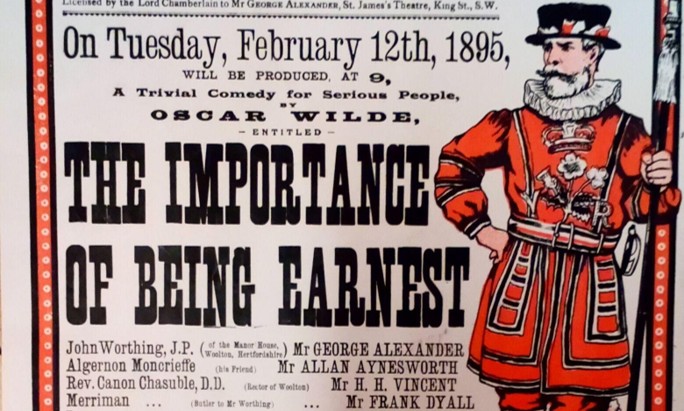
Prism! Where is that poster?
It is part of the legend of Oscar Wilde that, when he was prosecuted for gross indecency, the managers of the two theatres where An Ideal Husband and The Importance of Being Earnest were being performed tried to keep the shows running by covering up Wilde’s name on the posters. An Ideal Husband had opened at the Theatre Royal Haymarket on Thursday 3 January 1895 and The Importance of Being Earnest had opened at the St James’s Theatre on Thursday 14 February 1895, so they had been running for twelve and six weeks respectively when the trouble started in April. The lease of the Haymarket was held by Herbert Beerbohm Tree but he was not the producer of An Ideal Husband as he had taken his company on tour in the USA, sub-letting the theatre to matinee idol Lewis Waller (who played Sir Robert Chiltern) and his business partner Harry Morell. The actor-manager George Alexander (who played Jack Worthing) had been running the St James’s Theatre since 1890 and had turned a theatre that had a reputation for being hard to fill into one of the most fashionable in London. Alexander knew Wilde well as he had produced Lady Windermere’s Fan in 1892, Morell and Waller less so as this was their first venture in London theatre management.
The publicity for a show in the 1890s would have included the author’s name in three areas: the poster, the programme and the classified advertising that appeared in The Times and other papers giving details of the performances at West End theatres for that day. At the beginning of the runs of An Ideal Husband at the Haymarket and The Importance of Being Earnest at the St James’s, Wilde’s name was prominent in all three because his celebrity was as much of a draw as the actors in the cast. By the end it had disappeared, although Charles Wyndham restored it when An Ideal Husband transferred to his Criterion Theatre.
Waller and Morell panicked first. Wednesday 3 April was the first day of Wilde’s ill-advised action for criminal libel against the Marquess of Queensberry when everything started to unravel. However Wilde’s name had disappeared from the newspaper advertising for An Ideal Husband on the Saturday before that, suggesting that Morell and Waller had some indication of what was coming down the tracks. This might have been due to the fact that the part of the manservant Phipps in An Ideal Husband was being played by Charles Brookfield who entertained a passionate hatred of Oscar Wilde that he was only too willing to share with anyone who would listen. Waller no doubt heard a good deal backstage. Exactly one week later, on Saturday 6 April, Wilde’s name also disappeared from classifieds for Earnest. George Alexander could scarcely be in any doubt by that stage of the trouble that lay in store for Earnest as, two columns to the left of the theatre listings in that day’s paper, was an article headed ‘Arrest of Oscar Wilde’. It contained the information that:
Mr Oscar Wilde’s name was yesterday removed from the play-bills and programmes of the Haymarket and St James’s Theatres, where his plays An Ideal Husband and The Importance of Being Earnest were performed respectively.
In fact, this probably happened a few days earlier. In his book Oscar Wilde on Trial, Joseph Bristow (page 150) quotes from an article that appeared in the Western Mail on Saturday 6 April, the day of the Times article and of Wilde’s first appearance in Bow Street magistrates court, so it must have been based on interviews carried out one or two days before. The enterprising journalist had visited Harry Morell and George Alexander to ask them what effect the Wilde scandal was having on the box office.
In order to obtain a practical opinion as to how far the verdict is likely to affect the plaintiff’s position as a dramatist, a St James’s Gazette representative waited upon Mr H. H. Morell, of the Haymarket Theatre. Mr Morell… assumed an air of imperturbability, and pointed to a large poster. ‘That is the only answer I can give.’
I looked at the poster, which bore the words, ‘On Saturday, the 13th April, An Ideal Husband will transfer to the Criterion Theatre.’
‘I fancy,’ I said, ‘I observe a change – an omission. You seem to have departed somewhat from the customary form!’
‘Quite true. The author’s name has disappeared from the bills, nor does it figure any longer in the advertisements in the daily papers.’
The journalist then went to the St James’s Theatre to ask George Alexander the same question.
‘You know, perhaps,’ I said, ‘that your neighbours, Messrs Waller and Morell, have withdrawn Wilde’s name from their bills and advertisements?’
‘The same step,’ answered Mr Alexander, ‘has been taken by myself in regard to the latter, and will also take effect in the case of the former as soon as the printers can complete the alterations’.
Waller and Morell had rented the Haymarket from Tree from the beginning of January to the end of March, but on 23 March they announced in their classified advertisement in The Times (page 10) that they had negotiated with Tree to extend the run to Saturday 6 April. What they didn’t announce was that they were so confident of the success of the production that they were also negotiating with Charles Wyndham to transfer it to the Criterion where it would open on Saturday 13 April. The reason for the one-week gap was that the week commencing Sunday 7 April was Passion Week when many people felt that theatregoing was inappropriate. The legal obligation on theatres to close for the whole week had been lifted in 1862, after which only closing on Good Friday was obligatory, but nevertheless some theatre managers still observed at least partial closure. The Haymarket closed for the whole week, the St James’s closed on Thursday, Friday and Saturday, and the Criterion closed up to and including Good Friday and then opened with An Ideal Husband on Easter Saturday.
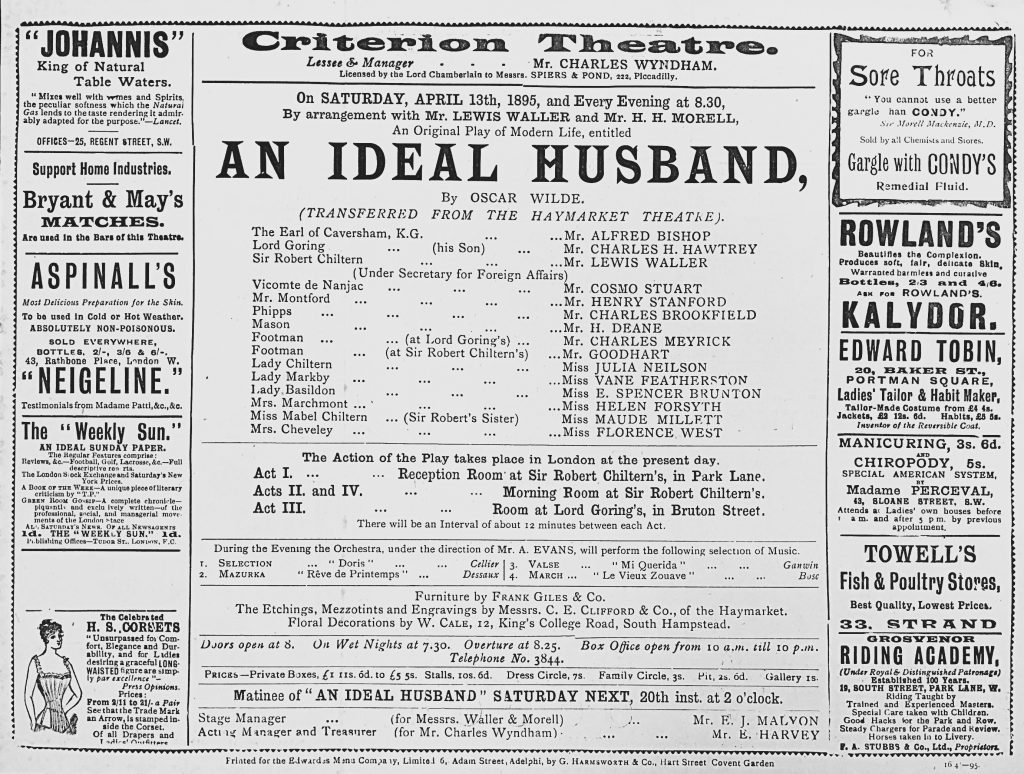
Charles Wyndham, to his eternal credit, refused to go along with the idea that Oscar Wilde was too toxic to be named. Wilde was back in the programme (see above) and in the press advertising that described An Ideal Husband as ‘Oscar Wilde’s successful play’. But what about the poster?
Several years ago I realised that I had never seen any poster for either of the plays at any of the three theatres. As far as I know, they have never been published in any Wildean literature, so I wondered if any copies survive. The obvious place to look would be the Theatre and Performance Collection of the Victoria and Albert Museum, but that was closed for four years during its move from Hammersmith to a new building on the old Olympics site in Stratford which is called V&A East Storehouse. It opened there in 2025 so I requested the files for the Haymarket, St James’s and Criterion theatres for 1895. Sadly, there were no posters in the files, but the V&A does have one poster for The Importance of Being Earnest in another part of its collection.
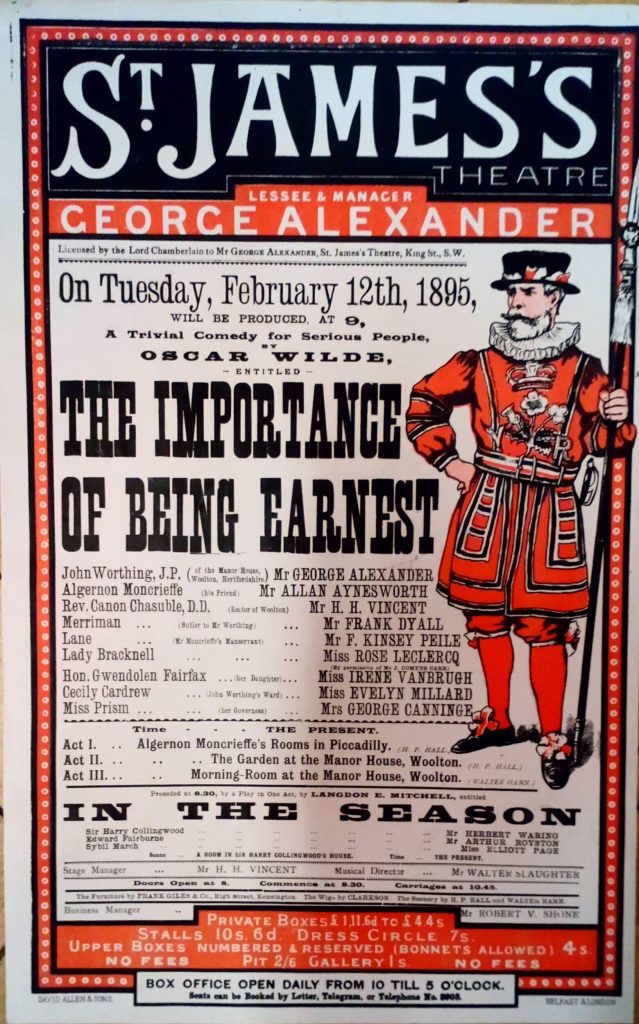
It has a smart design, typical of the stylishness of George Alexander’s management, and involves two-colour printing in a format that could be adapted from show to show. This was not typical, at least not of theatres that were presenting what we call straight plays. Dazzling colour posters were commonplace in the 1890s for big shows like pantomimes, melodramas, musicals and circuses, but the managers of smaller theatres who produced what used to be called ‘the legitimate drama’ had to content themselves with simple black text on large sheets of white paper. The photograph below shows the front of Haymarket when it was presenting Victorien Sardou’s Fédora only a few months after An Ideal Husband had closed. The posters can be seen pasted onto the front of the building. At the end of the run, someone would go out with a scrubbing brush and a bucket of soapy water to remove them and put up the posters for the new show. There was probably no one asking: ‘Has anyone kept a copy of the poster for the files?’ I doubt if any posters survive for An Ideal Husband, either at the Haymarket or the Criterion, but I would be delighted if readers of Intentions could prove me wrong.
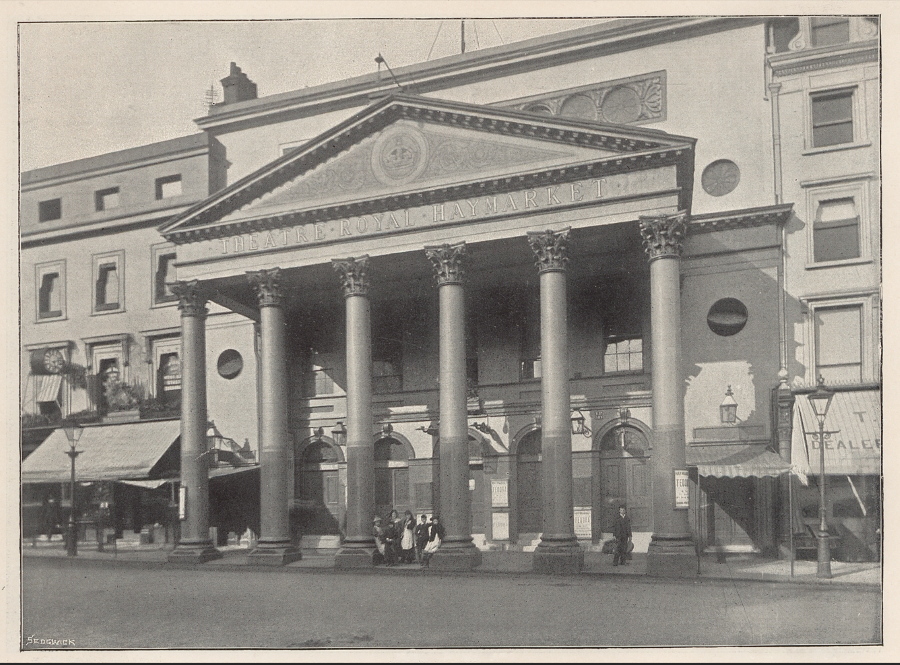
The front of the Theatre Royal Haymarket during the run of Fédora, 25 May to 20 July 1895
An Ideal Husband lasted for only two weeks at the Criterion, closing on Saturday 27 April. It had achieved 108 performances at the Haymarket and 14 at the Criterion, a total of 122. Earnest limped along for another week-and-a-half at the St James’s, closing on Wednesday 8 May after 84 performances. A spreadsheet showing all performances of both plays can be seen on the Society’s website https://oscarwildesociety.co.uk/resources/.
ORDINAL NUMBERS
Nineteenth-century managers used the number of performances achieved by a successful production in their marketing. We are used to being told the number of years that a production has been running, but in the nineteenth-century, when runs of a year or more were extremely rare, it was the actual number of performances. If a play made 100 performances – about four months – that was considered good. Sometimes managers would mark the stages on that journey – 50 performances, 75 performances.
In the days before computers, every theatre had a ledger in which one page was allocated to each performance. At the top of the page the bookkeeper would write the title of the play, the date and the ordinal number of the performance. All the manager had to do when drawing up the copy for the newspaper advertisement was ask the bookkeeper for the ordinal number of that day’s performance. The newspaper advertisements for both An Ideal Husband and The Importance of Being Earnest made frequent references to these ordinal numbers. Unfortunately they were almost all wrong.
George Alexander’s mistake was to forget that the second Wednesday of the run was Ash Wednesday. By the 1890s the legal prohibition of performances on Ash Wednesday had been lifted but some managers still observed it. On Ash Wednesday 1895 – 27 February – the Haymarket and the St James’s theatres were closed, even though other West End theatres were open. Earnest opened on Thursday 14 February and on the following Saturday it was announced that the first midweek matinee would take place on Wednesday 27 February. The mistake was immediately spotted and on the following Monday it was announced that the first midweek matinee would take place on 6 March. It seems that whoever was keeping the ledger had already created the pages for two performances on 27 February and was unwilling to score them through and revise the ordinal numbers. As a result, all ordinal numbers for Earnest were out by two, e.g. Saturday 30 March was announced as the 50th performance but it was the 48th.
The situation at the Haymarket was more confusing, probably because of Waller and Morell’s lack of experience. Saturday 16 February was announced as the 50th performance and this was correct, although it was the matinee not the evening performance. March 7 and 8 were both announced as the 75th, although the actual 75th was on 9 March. March 23, 25, 26 and 28 were all announced as the 100th, although the actual 100th was the evening performance on Saturday 30 March. The final performance at the Haymarket on 6 April was announced as the 111st but it was the 108th. The mistake was carried over to the Criterion where the first performance was announced as the 112th and the situation was made worse when the performance on 17 March was announced as the 115th and that on the next day was announced as the 117th. ‘So who’s counting?’ the flamboyant impresario might ask. Alas, those of us who toil in the mines of theatre history have to do so.
ROBERT WHELAN
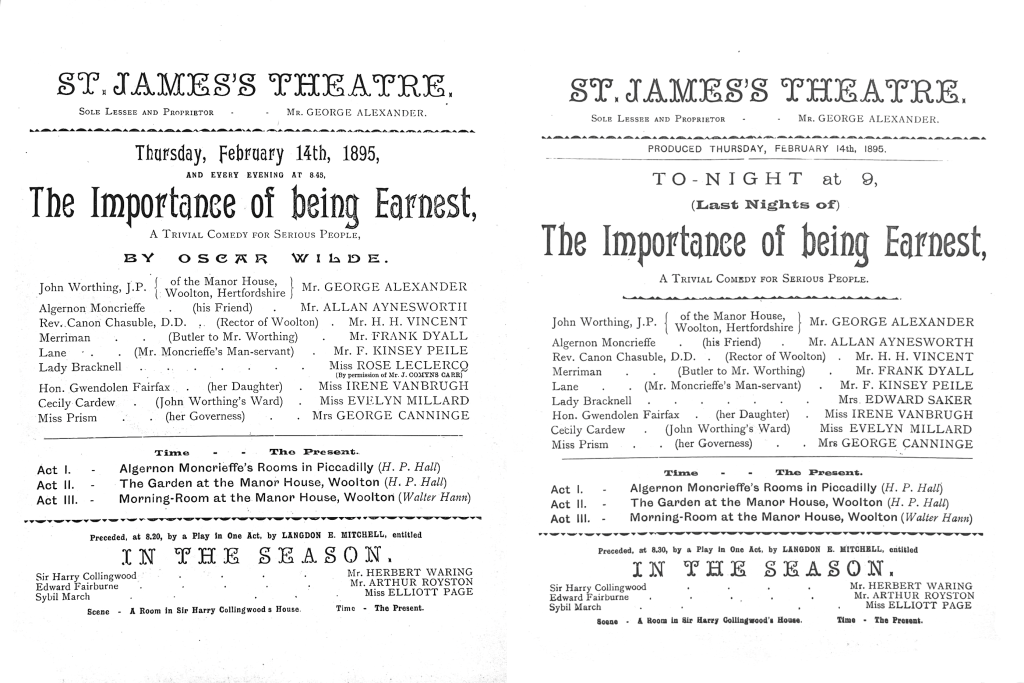
Two programmes for The Importance of Being Earnest. Can you spot the difference?
Note: This article appeared in the June 2026 edition of Intentions, the Oscar Wilde Society’s newsletter, which members receive free.