
“The trials of Oscar Wilde may be presumed to have taken place during the interval.”
This odd and ominous line was spoken by Micheál Mac Liammóir at the start of the second half of his celebrated one-man show, The Importance of Being Oscar. The performance was released in 1962 by CBS as a two-record set. The records were sold separately, and one Oscar Wilde Society member recently recalled only having the first of these LPs, which ends with Oscar receiving the Marquess of Queensberry’s infamous card and writing to Robbie Ross, “I don’t know what to do.” Now there’s a cliffhanger for you!
In fact, the gap between Part I and Part II, be it an interval or a change of records, represents a vast gulf of secrecy and shame. Mac Liammóir, himself a gay man, lionized Wilde at a critical moment in history, beginning in 1960 when two feature films about Oscar appeared in cinemas. But even as the cultural project to reclaim Oscar gained momentum across media, Mac Liammóir drew a safety curtain across the trials, blocking the light they shed on how Wilde lived his private life. It was too early to try to reclaim that side of Oscar.
Mac Liammóir performed his show until 1976; Simon Callow had a West End run with it in 1997-1998. Now Alastair Whatley has stepped into the role for a touring production that included a month-long run at the (Finsbury) Park Theatre.
Director Michael Fentiman has streamlined the script a bit, and worked in an homage to Mac Liammóir. The show begins with a recording of Mac Liammóir’s voice from the original production. Simon Callow describes it in the programme’s essay as a “voice of uncommon richness”, and so it is. However, to modern ears listening to the two albums the richness swells into decadence, like a heavy Christmas pudding soaked in brandy. Whatley doesn’t aim for such a luxurious timbre, striking a good balance between conversational and portentous. He grips our attention without overpowering us.
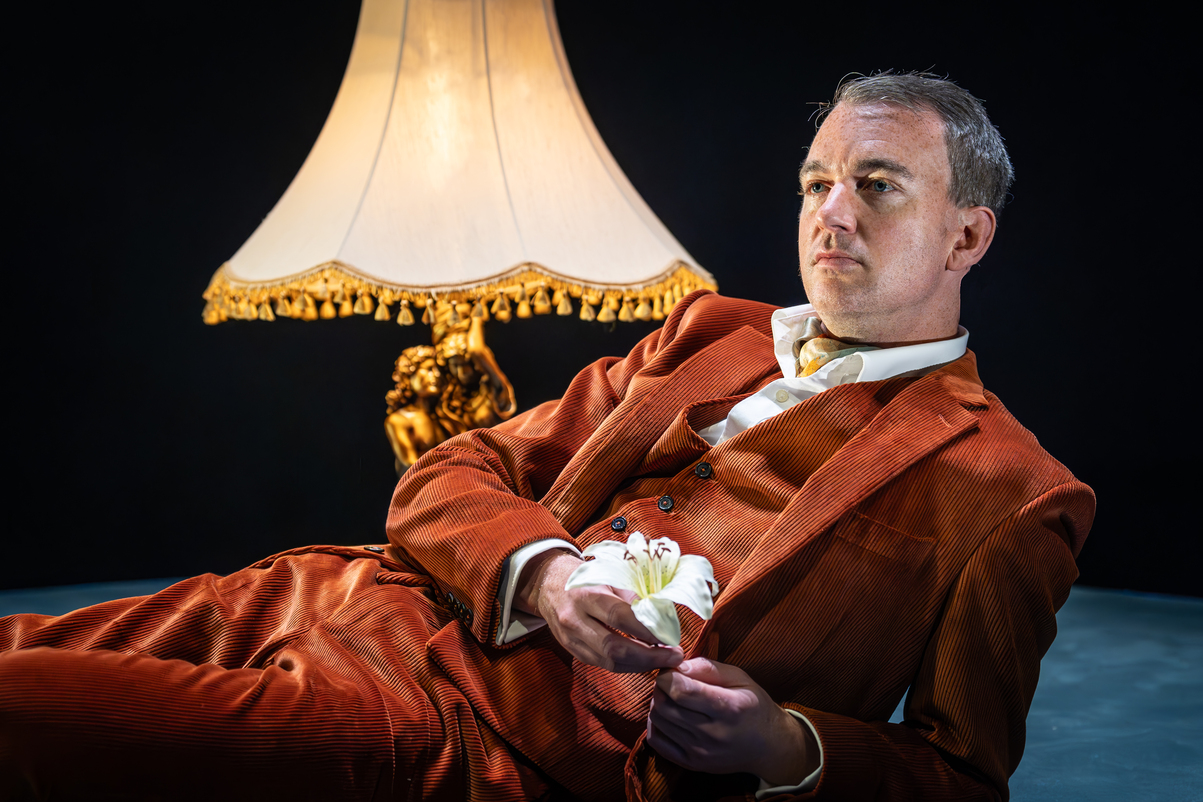
The show doesn’t require Whatley to be Oscar, though his costume – a gorgeous burnt-orange three-piece corduroy suit, cravat and green carnation – certainly harkens back to Wilde’s dandyism. Rather, Whatley tells us Oscar’s story, with frequent in-character quotations from Wilde, his plays and poems, and even Justice Alfred Wills. All of these brief episodes lend variety to the narrative, and Whatley is brilliant at sliding between roles. He also excels at the limited movements he can make on a small stage, giving interest and emphasis to the show without striking ridiculous poses. His performance rightly earned positive notices, including a five-star review in The Times.
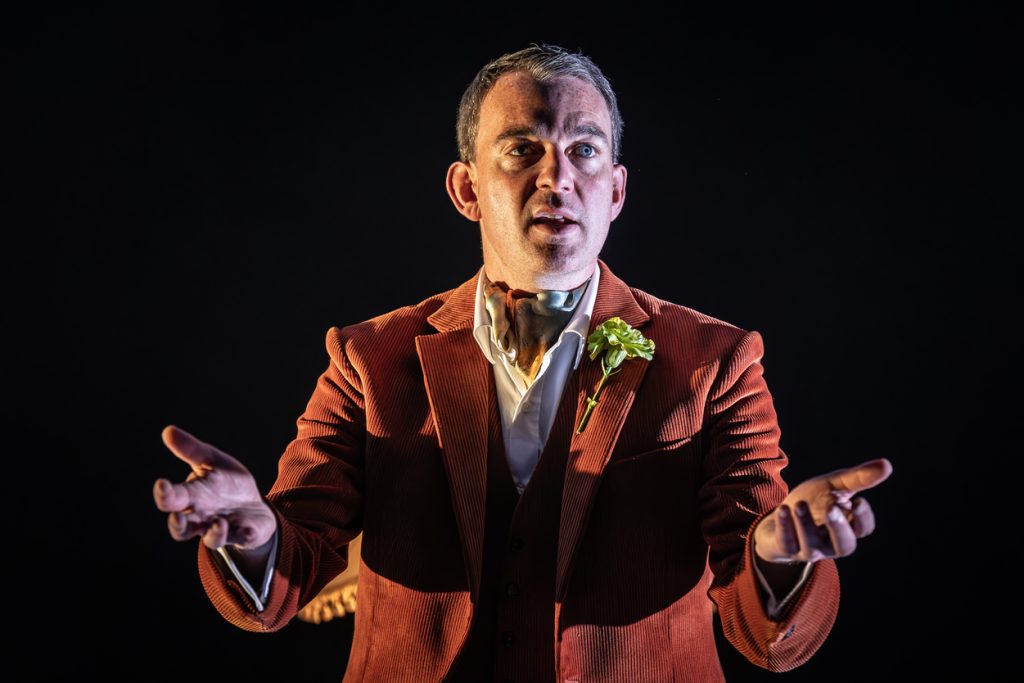
Photo by Marc Brenner
While the show briskly and sympathetically relates Wilde’s life, it’s so compressed that certain aspects might confuse audience members who don’t know the story. This is most evident concerning the trials: as soon as he brings suit against Queensberry, we are told, Wilde is arrested. The fact of there being three trials isn’t mentioned, except in an excerpt from De Profundis.
The structure preserves the original’s, and while this makes so much dramatic sense as to be inevitable, it does run the risk of making Wilde’s rise seem like merely a prelude to his fall. The second act covers just Wilde’s last five years, and even the first act is stained at the end by Queensberry and the lawsuit. On reflection, this seems unfair. Wilde was a shell of his former self once he went to prison — why should that shell share equal billing with Wilde the author, the wit, the playwright, the poet, the husband, the father, the lover, the philosopher? This isn’t the fault of the play but of Oscar’s legacy; he has become the child of Thalia and Melpomene, half comedy, half tragedy, but Melpomene got custody. Perhaps no martyr can hope for more.
DARCY SULLIVAN
The Importance of Being Oscar by Michael Mac Liammóir, directed by Michael Fentiman, runs at the Park Theatre in London from 22 July to 22 August. It is scheduled to return to the Reading Rep Theatre from 2-14 February 2027. A streaming version is available to rent at originaltheatre.com until 29 February 2028. The reviewer attended the performance on press night, 27 July 2026.